
FROM THE BOARD ROOM: Board’s Perspective
Moving Technology Over the Past 20 Years;
From Cube Sheets to AI-Powered Logistics
June 11, 2025 marks the 20th anniversary of my husband Robert Myer’s passing.
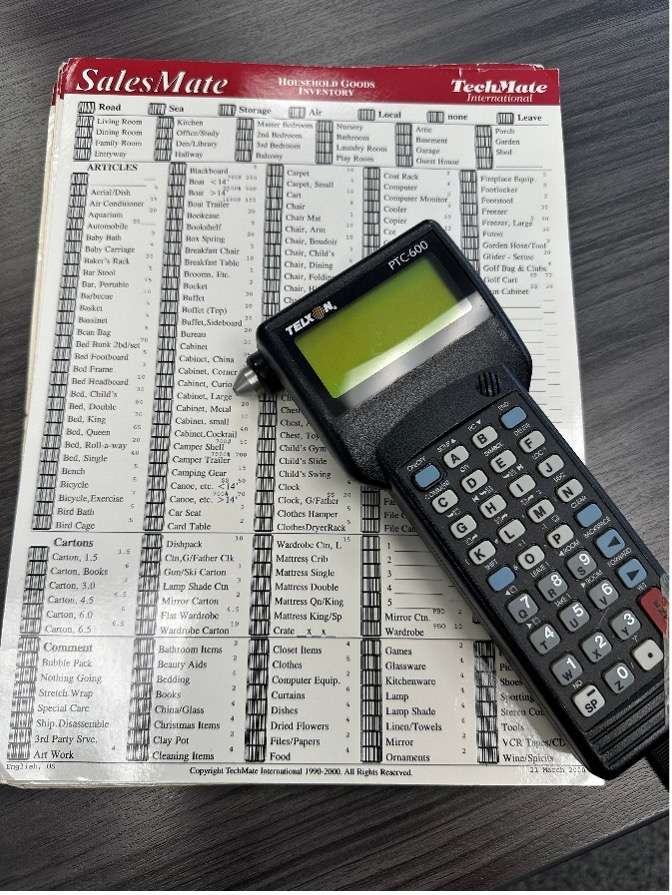
As many of you know, when Rob died, I took over the business and with warp speed, we went from 2005 to 2025. I can also remember when Rob came home all excited about a new “high tech” inventory scanning device using bar codes. He could also print and leave the proposal with the customer on the spot. Robert felt very cutting edge and was indeed ahead of the curb.
Over the past two decades, the moving and relocation industry has undergone a technological revolution. What was once a paper-heavy process relying on manual estimations has transformed into a data-driven, automated, and highly efficient system. At the heart of this transformation is the shift from basic tools like cube sheets to advanced software and artificial intelligence.
In the early 2000s, cube sheets were the standard tool used by moving companies to estimate the volume of items to be moved. These printed sheets listed common household items with pre-assigned cubic feet values. Movers would tally up quantities during in-home surveys, providing a rough volume estimate for truck space and pricing. While functional, this system was prone to human error and time consuming.
As computers became more affordable and widespread, industry began shifting to digital inventory systems. Software replaced paper cube sheets with electronic versions, enabling easier adjustments, storage, and calculations. CRM systems also started emerging, allowing companies to better manage customer relationships and scheduling. We used Techmate and Mr. Mover at the time.
With the rise of smartphones and tablets, on-site digital inventory collection became the norm. Movers could now walk through homes with tablets, taking pictures and inputting inventory directly into software. GPS technology also became a staple, improving routing efficiency and allowing customers to track moving trucks in real time. Oh and remember when you had to draw the route out on a map for the drivers. Thank goodness for Waze and google maps!!
Cloud-based moving software platforms emerged, enabling companies to centralize operations, access files remotely, and collaborate seamlessly. Automation became more prevalent, with features like auto-generated estimates, online booking, and digital signatures reducing manual workload. Customer portals allow self-service and better communication.
The COVID-19 pandemic accelerated the adoption of virtual tools. Virtual surveys using video calls and AI-driven estimation software became widespread, reducing the need for in-home visits. AI is now used to analyze inventory, optimize packing, and predict costs based on historical data. Machine learning algorithms help companies forecast demand, reduce fuel costs, and improve customer satisfaction.
From humble cube sheets to sophisticated AI systems, the moving industry has embraced technology to improve accuracy, efficiency, and customer experience. As innovation continues, the next decade promises even more advanced solutions and sustainable logistics models. I think Robert would have loved all of the advances that the Moving Industry has embraced.
Cindy Myer, Owner/President Ridgewood Moving Services, Co. & NJWMA Board of Director


Find a Mover
Find the right mover for you by searching our database of qualified NJ movers.